

Terrorist groups now use armed drones to attack military facilities
The new Chief of Defence, General Olufemi Oluyede and the Chiefs of Staff for the Army, Navy and Sir Force, recently sworn-in by President Bola Tinubu, should do well to recognise that Boko Haram and its splinter unit, the Islamic State West Africa Province (ISWAP) have changed their attack tactics in the northeast, as recent incidents have indicated.
The terrorists are increasingly using armed drones and decor movements, and manoeuvring their way to carry out attacks, especially on military positions.
Security sources and residents in Borno who are familiar with the terror activities of the groups, told Sunday Sun the worrisome development.
Late November 2018, the Nigerian Army announced, for the first time, that Boko Haram was deploying drones to attack military bases and communities. This news came following the deadly attack on troops at Metele, a remote area in northern part of Borno. At first, many did not take this disclosure serious. Then came another revelation that Boko Haram flew drones in an attack at Damboa, a restive town in the southern part of the state.
Also in May, the army revealed that the terrorists had introduced armed drones in their attacks similar to those used in Israel or Ukraine.
“Since November of last year (2024}, we noticed the introduction of the use of armed drones to carry out attacks. Like you would find in Israel or Ukraine, these drones are difficult to detect by conventional radar” the Theatre Commander of Operation Hadin Kai Northeast, Maj Gen Abdulsalam Abubakar, told journalists at a press conference in Maiduguri.
Residents said the use of drones in the attack on military locations at Dikwa, Mafa, Gajibo in Borno State and Katarko in Gujba Local Government of Yobe State last week, accentuated claim of change of strategy by the terrorists.
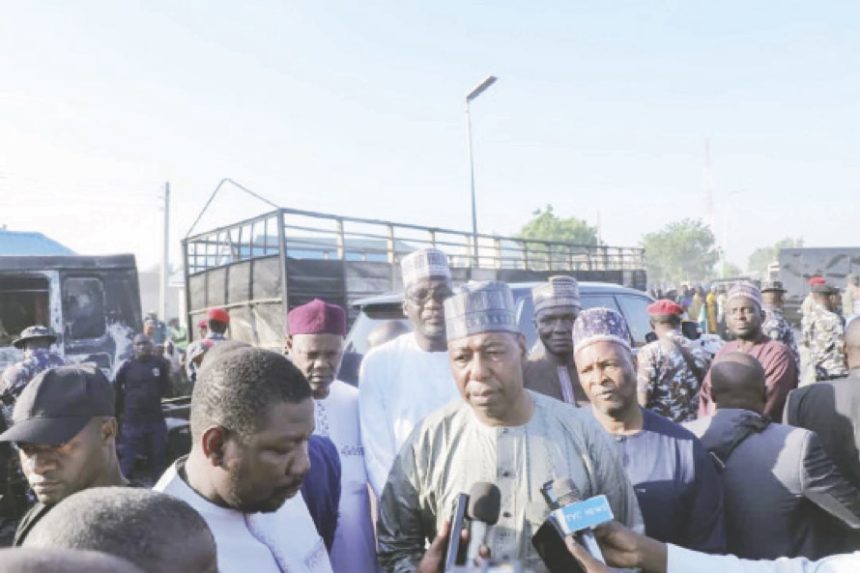
Borno State Governor, Babagana Zulum while in Mafa shortly after the attack on Thursday, appealed to the Federal Government to address the proliferation of armed drones in the hands of Insurgents or terrorists. He also called for stronger measure to secure the nation’s borders.
“Our borders need to be strengthened and our airspace needs to be strengthened as well. This is something that we need to address urgently; this is not an issue confined to Borno alone. This is the right time for the security architecture to thoroughly look into strengthening the capability of our airspace to curtail the use of armed drones by terrorists,” he stated.
Boko Haram/ISWAP’S link with ISIS and other terror groups in the Sahel region, may have provided platform for sourcing armed drones and other technology being used by the terrorists in the Northeast, two security sources maintained.
They also said the manoeuvring of the terrorists from the Cameroon axis in the recent be attacks in Borno towns, could be a decor to cover up their actual departing points.
“They might have moved from somewhere to Cameroon axis in smaller groups for days. It is also part of the terrorists new tactic to cover up their movement knowing full well the military monitors their usual routes,” one of the sources said.
Curiously Borno shares porous borders with Chad and Niger, both Sahel nations facing terrorism and rebel violence, and Cameroon in the central Africa.
There are stronger indications that the terrorists rely on intelligence from some collaborators within the communities and perhaps in the security circle, some presidents argued.
According to them, the precision of the offensive against the military Super Camp at Ngamdu, along Maiduguri-Danaturu underscores the concern that the terrorists may be relying on communication technology with the collaboration of informants to monitor military positions.
It was also argued that the manner at which the terrorists laid explosives on major road leading to the Super Camp to prevent troop reinforcement during the attack and without anyone noticing or reporting exposes the gaps between the civilian population and the military.
“Could it be some community members saw the terrorists planting IEDs but refused to alert the military or were they unaware that it is part of the new tactics for of Boko Haram,” a community leader in Maiduguri who preferred not to be mentioned in the report, asked.
A Maiduguri-based researcher and security affairs commentator, Dr Babakura Bukar, urged the military to review its approach to tackle the current trend.
“The military should be more proactive. They should make use of intelligence and strengthen inter-agency collaboration,” he advised.
However, a security expert, Brig Gen Sani Usman (retd), maintained the response of the military to the drone-driven attack by the terrorists midweek in Borno and Yobe, was encouraging.
Usman told Sunday Sun the military troops showed gallantry in battle and decimated the terrorists and their drones in the fierce battle supported by the theatre air component.
Earlier in a statement on Friday, the former spokesman said troops kept the fighting spirit and neutralized the terrorists to ensure security of the area.
“This impressive, renewed vigour has also remarkably strengthened the operational synergy between the ground forces and the inspiring air component, culminating in sweeping, coordinated and resounding victories,” he said.
He, however, urged federal and state governments to support the military with logistics, improved welfare, more equipment to defeat terrorists, insurgents and other security threats in the country.
